Full Size Cable Differences: Direction of Travel and Circuit Shape

When choosing a wakepark, the type of facility and the obstacles present are among the first things that come to mind. For those with a few sessions under their belt, however, there are other details that can make a real difference in the way you experience riding.
One of these is the direction of travel of the Full Size.
A cable can rotate clockwise or counterclockwise, and especially in the early stages of learning, this characteristic can affect the ease with which turns are taken. This is linked to one's natural gait—regular or goofy—and how the circuit forces the rider to use the heelside or toeside edge.
The shape of the track also plays a role. A full-size track with a more rectangular configuration features more pronounced changes in direction than a multi-sided track, where the trajectory changes are more progressive.
This doesn't mean there's a single best direction of travel or track shape. These are simply features worth knowing, especially if you're looking to choose a full-size bike based on your riding preferences and cable experience.
Clockwise or counterclockwise: what does it mean?
When we talk about the direction of travel of a Full Size, we simply mean the direction in which the trolleys travel around the circuit.
The cable can then turn:
- clockwise;
- counterclockwise.
This is a technical detail that you can find indicated on the wakepark's description and which can be useful when you want to compare multiple facilities.
At first glance, it might seem like a minor detail. In reality, the direction of travel determines how you approach turns along the track and therefore which edges of the board you use most.
To understand why, you must first consider your natural position on the board.
Regular and Goofy: Why Pace Matters
In wakeboarding, we speak of regular when the left foot is in front and goofy when it is the right.
It's not just the position of the feet that changes: it also changes the way the rider perceives and approaches certain movements in the specific context of each facility.
When you ride a Full Size, in fact, the turns can be tackled using the heel side edge, that is the one on the side of the heels, or the toe side edge, that is the one on the side of the tips.
For a rider who is still building their technique, not all turns feel equally natural.
In general, heelside turns are often perceived as easier and less tiring, while toeside turns can require more body control, especially when the change of direction is marked.
With experience this difference tends to reduce and the rider learns to manage both situations more naturally.
For beginners, however, it can be a factor to take into consideration. If you want to delve deeper into wakeboarding, the difference between the two strokes, and better understand what it means to be regular or goofy, you can consult the beginner's guide dedicated to discovering wakeboarding.
How the direction of travel changes the curves
The direction of travel of the Full Size determines the sequence of curves you will encounter during the ride.
Depending on the combination of regular or goofy and cable direction, some turns may feel more natural while others may require more attention.
This is precisely why two apparently similar Full Size bikes can give different sensations even without radically changing the obstacle level.
A regular rider may have a preference for a certain direction of travel and how to approach obstacles, just as a goofy rider might. However, there is no hard and fast rule that applies to everyone.
Personal technique, experience and habit play an important role.
Curve heel side
Heel side edge turns are often the ones that a beginner can manage most easily.
The body position can be more natural and allows you to control the trajectory without having to force the movement too much.
This doesn't mean they're always easy: a tight bend, taken at high speed or with an imprecise trajectory, can still cause difficulties.
Curved toe side
Toeside turns may require more control, especially when the rider has not yet developed good feel for the edge of the board.
The movement may feel less natural and it becomes more important to maintain correct body position without losing the edge.
Over time, however, these curves also become a natural part of riding.
For this reason, the direction of travel can be particularly interesting for those who are still inexperienced: choosing a circuit that more closely follows your natural pace can make the first sessions more enjoyable.
90 degree bends
Among the situations that can most test a beginner are the sharpest changes of direction.
A 90-degree turn requires decisive management of the cable's trajectory and direction. If taken on the less natural edge, it can be particularly challenging.
It's one of the reasons why the circuit configuration can affect the overall feel of a Full Size much more than it might seem.
The shape of the circuit changes the way you approach the corners
The direction of travel is not the only factor to consider.
The shape of the circuit also influences the way the cart changes direction and, consequently, the sensation the rider perceives during the ride.
Full Size circuits can have different configurations and, to simplify, we can encounter circuits with more rectangular shapes or with a greater number of sides.
More rectangular circuits
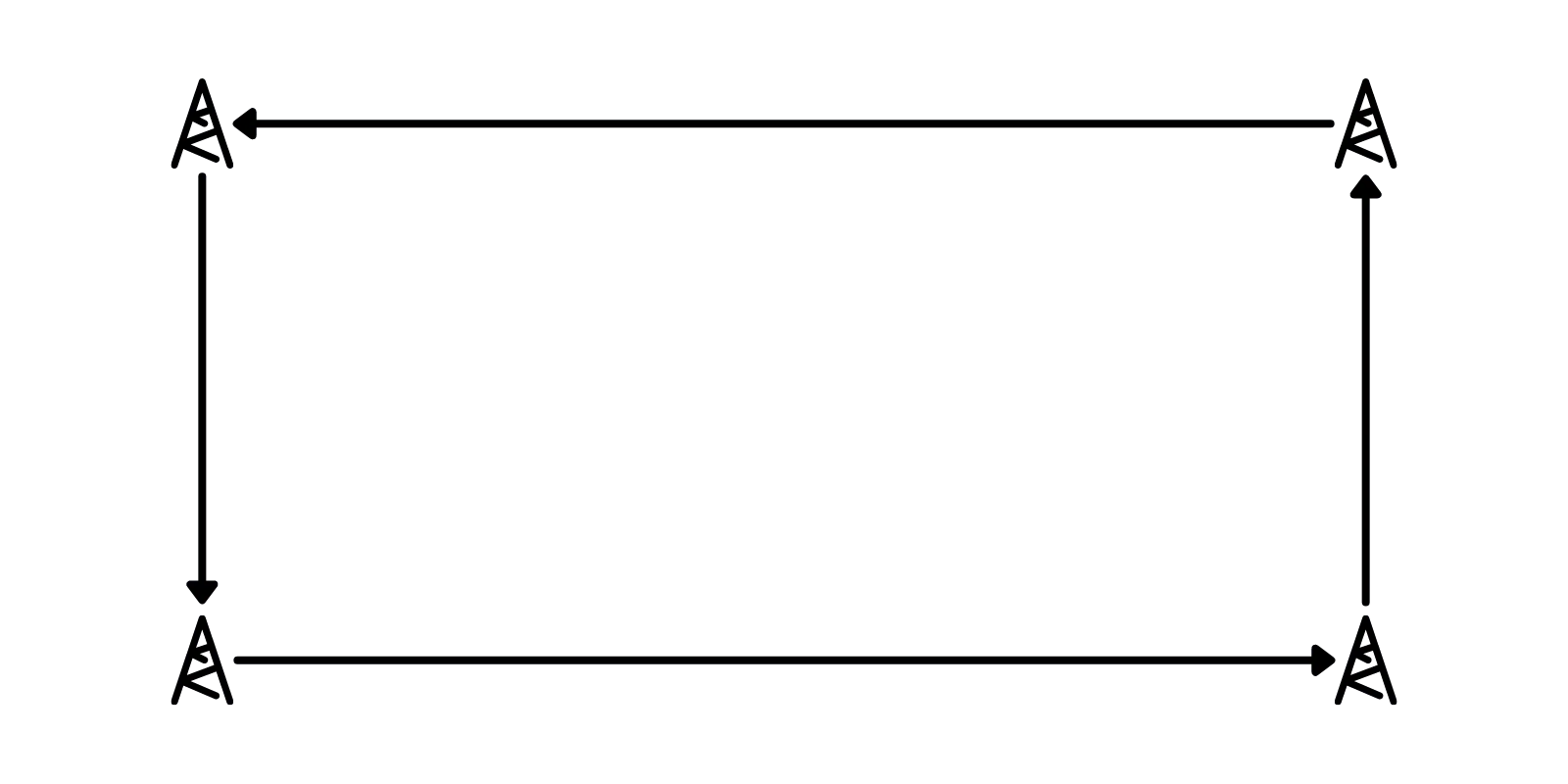
A rectangular configuration generally has sharper changes in direction.
The cart has to change its trajectory more in the curve areas and the transition from one section to another can be more marked.
For the rider, this means tackling more defined curves, where it becomes important to arrive on the right trajectory and maintain control when changing direction.
This doesn't necessarily mean that a rectangular course is worse or more difficult overall. It's simply a configuration that can make turns more obvious and require more precise handling. The advantage of a four-sided full-size course, however, is that it offers longer straights and fewer changes in direction, which, despite being more pronounced, leave more room for steering the board and taking a breather.
Pentagonal circuits

By adding sides to the circuit, the change of direction can become progressively less abrupt.
In a pentagonal configuration, compared to a rectangle, the changes in trajectory can be more distributed along the path, except for the last two corners of the lap.
Even in this case, however, the geometric shape should not be transformed into a difficulty ranking: the actual behavior depends on the specific configuration of the system, the length of the sections and the angle of the curves.
Hexagonal circuits

With even more sides, the circuit can offer more progressive changes of direction on all corners.
The transition from one direction to another tends to be less concentrated in a single, very sharp curve, making the movement of the trolley more fluid.
For a rider just learning, this feature can help make the ride more intuitive. For an experienced rider, however, it may simply be a matter of personal preference based on the type of riding they're looking for.
The shape of the circuit, therefore, does not alone determine the difficulty level of a park. It is one of the elements that contribute to its character.
Which direction of travel should you choose?
If you are new to riding a Full Size and already know your natural gait, the direction of travel can be an interesting detail to evaluate.
Generally speaking, a regular rider may find a certain direction more natural than a goofy rider, who may have the opposite preference.
This depends on how the curves appear in relation to your natural edge and, above all, how familiar you are with heel side and toe side.
However, it is not correct to say that a regular must necessarily choose a clockwise Full Size or that a goofy must necessarily look for a counterclockwise system.
With experience, you learn to manage both situations, and many riders don't consider the direction of travel at all when choosing where to go, instead prioritizing the quantity and types of obstacles available.
The direction of travel can become an interesting criterion when:
- you're still learning to handle the curves;
- you have a strong preference for a certain edge;
- you are comparing multiple similar Full Sizes;
- you want to try a system with features that better support your riding.
There is no one best Full Size for everyone
The direction of travel is just one of the elements that characterise a cable.
A full-size that's particularly enjoyable for one rider might not be as enjoyable for another. The choice can depend on your pace, experience, technique, course configuration, and even simply personal preference.
An experienced rider, for example, might have no problem riding both directions and prefer a park for the quality of the obstacles, the layout, or the atmosphere.
For those who are still learning, however, knowing these details can help understand why some circuits immediately feel more natural than others.
And there's another aspect: learning to turn switches allows you to gradually reduce your dependence on your natural position and acquire greater versatility on the cable.
How to find a full-size car with the direction you prefer
If you've already developed a preference for facing the direction of travel, you can also use that when looking for a new wakepark.
In the Directory Wakesquare The direction of travel is indicated in the technical information for full-size lifts. This information can also be used as a search criterion: you can filter wakeparks by lift type and further narrow your results by choosing clockwise or counterclockwise.
This way, instead of opening dozens of tabs one by one, you can start directly from the systems that match the features you're looking for.
You can then use the Directory, for example, to search for:
- Full Size → clockwise
or:
- Full Size → counterclockwise
and then compare the individual cards to better understand the facilities, obstacles, services and other features available: look for a Full Size in the Directory.
Let's learn to read a full size
Knowing these aspects also changes the way you look at a wakepark. It's no longer just a matter of whether you have the basics to tackle a full-size circuit. The direction of the cable, the shape of the circuit, and the way the turns are taken all contribute to the familiarity you feel during a lap.
And, above all, the more experience you gain, the more interesting it becomes to be able to choose a spot not only based on your natural direction of travel, but also because it offers exactly the layout and characteristics you want to find in the water.
Read more about Wakesquare
- Regular or goofy: discover your natural wakeboarding stance — understand the differences between the two and how they affect your ride.
- Two Towers or Full Size: Differences Between Cable Wakeboard Facilities — to learn more about the characteristics of the two main types of cable.
- Wakeboard Near me: how to find the right wakepark — to search and compare systems in your area.
- Switch riding in wakeboarding: how to learn to turn with the other foot — discover how to develop greater control even in the opposite position to your natural one.
- First day at the cable park: what to know before you start — to find out what to expect during your first session at the cable park.
About Wakesquare

Share this article


Advertising provided by Google
Recently Read
Amazon Affiliate Advertising