Tantrum wakeboard: trick tutorial and tips to improve
In this article, we focus on the topic of cable tantrum, through a specific tutorial for the kicker that is based on the precious advice of JB ONeill. Here you will find all the information and useful tips provided by JB to learn this technique or to perfect its execution.
What does tantrum consist of?
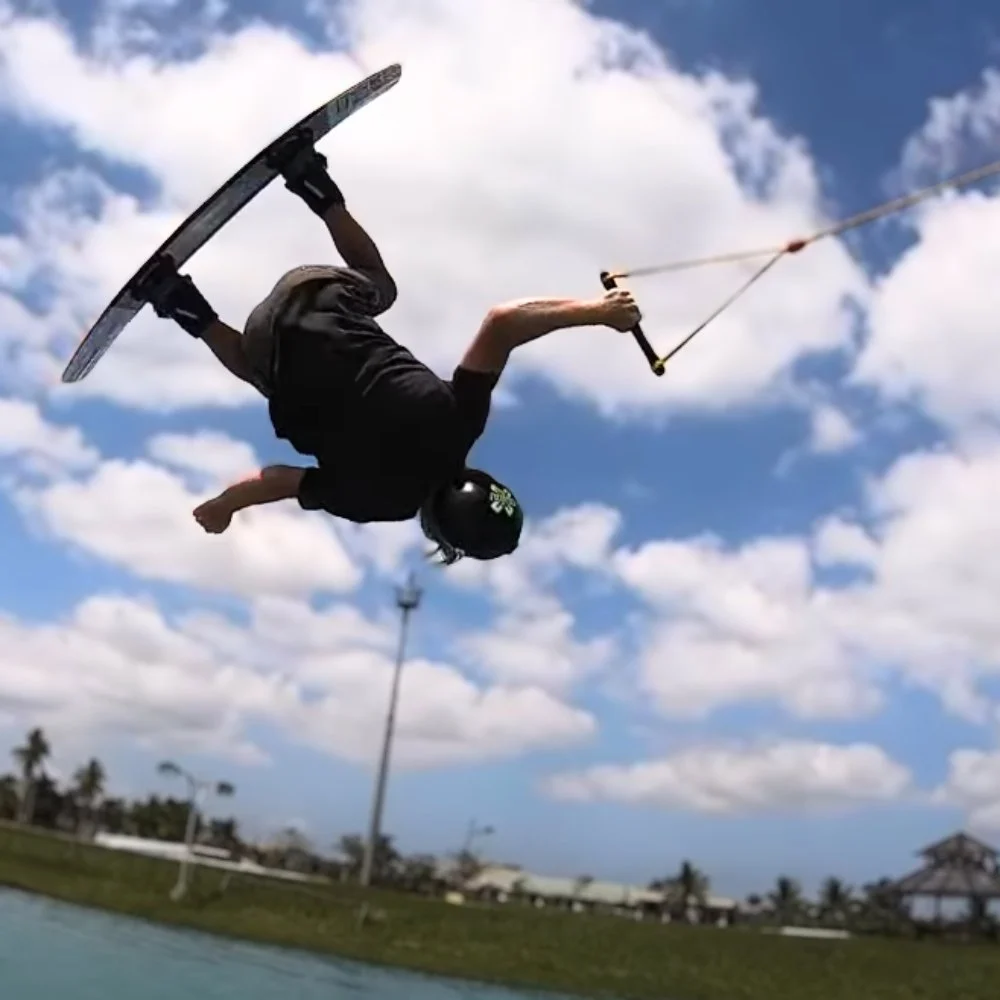
The tantrum in wakeboarding is the main trick that belongs to the category of "tantrum tricks". These tricks involve the rider performing a one-handed jump into the bar with a full 360-degree back flip, plus all possible variations. Then, during the execution of the tantrum, the rider launches himself into the air and performs a full back flip with his body, bringing the board over his head, and landing back in the same starting position; all while maintaining only the front hand on the bar handle. This trick requires considerable skill, balance, elevation and coordination to be successfully executed. Once mastered, the tantrum becomes one of the most spectacular and rewarding tricks.
Tantrum wakeboard tutorial
To better understand the execution of the cable tantrum from the kicker, we have selected the video tutorial released on Youtube by JB ONeill. Through this visual guide, you will have the opportunity to learn all the steps necessary to perform it correctly.
JB ONeill, in the video tutorial, provides a detailed explanation to perform the tantrum in an accessible way, carefully following the precise instructions below.
Before starting, JB emphasizes that it is not necessary to know other inverts or air tricks to learn the tantrum. The only essential thing is to know how to do a simple heelside jump from the kicker, i.e. cutting on the heels. However, he also emphasizes how useful it can be to know how to do a back flip first on a trampoline, a diving board or in any other way.
Constant medium cut: step 1
The cut you need to do when you do a tantrum can be light, hard or medium intensity, but the perfect one is definitely a medium intensity heelside cut. You don't want to go too slow because you don't get enough lift, but you don't want to go too hard because you speed up the trick too much, so a medium intensity cut is probably perfect.
Kicker approach: step 2
It will be a little easier on a steep kicker because a shallow kicker won't give you that traction feeling, but it can be done on any kicker. After you've made a good, steady, medium intensity cut toward the kicker, you should release your back hand from the bar about 5 meters or so before the kicker.
Make sure you are well aligned parallel to the balance rope, because if you turn sideways before you flip back, the board could hit the rope, canceling the inversion. So, find a comfortable, parallel position, with the balance well centered forward, and the back arm behind like a rudder. This will be the easiest way to rotate the tantrum.
Moment of reversal: step 3
With a little courage it is time to perform the back flip, imagining that the board is crossing over your head, while you are upside down. Then, you need to find a safe momentum and perform the rotation, probably as you would do a back flip from a springboard. When you push off to give the right momentum from the kicker, you need to wait just a moment to feel the board coming off the kicker, then you can decisively launch the tantrum. Remember, do not hesitate, and remember to lift your neck well, looking back; if you can concentrate well on this last detail you will be able to flip the tantrum in the correct way and with much more ease.
If the kicker is less steep, meaning it doesn't have much elevation and is very long, you will have to push off very hard with your legs. Lean forward a little and then push off. This will help you flip. If the kicker is steep, you don't want to push off too hard because you might rotate more than necessary. So if the kicker is steep, push off gently and launch yourself back hard.
Execution and landing: step 4
Once you complete the rotation, you just have to look straight ahead, point at the water, bend your knees and then simply land.
Also, because you are flipping backwards and keeping your gaze in the same direction as you spin, it will be easier to aim for the water because you will start to see it about halfway through the tantrum. Once you start to see the water again, bend your knees slightly for the landing.
Practice and progression
Once you have mastered the basic technique of the tantrum, you can progress to more advanced exercises, including the different variations of this trick. Consistent practice of the tantrum, both from the kicker and in air tricks, is essential to improve muscle memory and achieve greater consistency in execution. With time, you will be able to perform the tantrum with style and apparent ease.
If you want to catch the tantrum, the easiest way is definitely the Indy. Just make sure that you bring your knees to your chest and that your knees are very bent so that it is easy to reach the board. If you lean forward and try to catch the board that way instead of bringing the board to your chest, it will be much harder. So make sure that you bring the board closer to you by bending your knees and then it will be much easier to catch it. You may not get it the first few times, but try and try and you will get it.
Variants of tantrum tricks in wakeboarding
In addition to the classic tantrum, which we have just illustrated, it is possible to enrich this acrobatic trick by adding unique elements that increase the spectacle and, consequently, the difficulty of execution. Below, we present a table with all the main variations of the tantrum.
| TRICK | DESCRIPTION | ABBREVIATION |
|---|---|---|
| tantrum | HS back roll. | TAN |
| Double tantrum | Double HS back roll. | 2TAN |
| Tantrum to fake | Tantrum with an FS 180 to land in switch position. | TAN 2 F |
| Tantrum to blind | Tantrum with a BS 180. | TAN 2 B |
| Moby Dick | Tantrum with one pass of the BS 360 balance bar. | MOBY |
| Moby-Dick 5 | Tantrum with one pass of the BS 540 balance bar. | MOBY 5 |
| Moby-Dick 7 | Tantrum with one pass of the BS 720 balance bar. | MOBY 7 |
| Wirly Bird | Tantrum with a BS (ole) 360. | WHIRY |
| Whirlwind 5 | Whirly Bird with an additional BS 180. | WHIRL 5 |
| Whirly Dick | Whirly Bird with a pass of the BS 360 balance. | WHIRL YD |
| Double Whirl | Double Whirly Bird (720 ole). | D WHIRL |
If you want to learn more about other types of wakeboard tricks, check out this article: Types and variations of tricks in wakeboarding
In conclusion
With the tutorial and valuable tips provided in this article, we hope we have helped you improve your tantrum. Remember the importance of following all the steps carefully and executing them correctly.
Regular practice will allow you to progress, and once you have acquired the basic technique, you can tackle more complex variations. Tantrum may seem intimidating at first, but with determination and consistency, you will be able to master it with ease.










About Wakesquare

Share this article



Advertising provided by Google
Recently Read


Amazon Affiliate Advertising